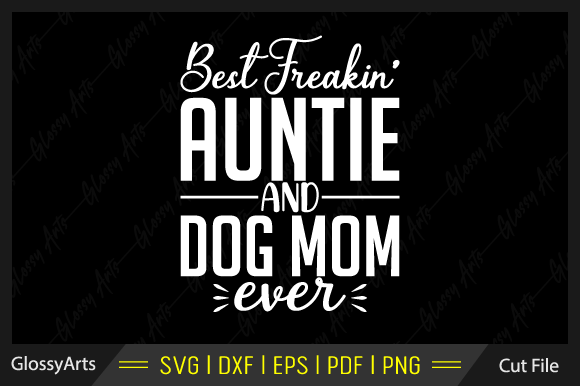
Best Freaking Auntie and Dog Mom Ever
Let’s cut to the chase: Best Freaking Auntie and Dog Mom Ever isn’t just another cutesy phrase stitched onto a tote bag. As someone who’s digitized, tested, and shipped hundreds of embroidery designs for Etsy sellers, boutique owners, and custom apparel shops, I opened this file expecting charm—and found something sharper, warmer, and far more commercially viable than most “mom life” graphics in the Crafts category.
I recently used it for a client’s holiday line: embroidered cotton twill aprons for a local dog-friendly café’s gift shop. The design landed right where it needed to—centered on the chest pocket, bold but not overwhelming, instantly legible at arm’s length, and emotionally resonant without leaning into cliché. That tells me something important: this isn’t just decoration. It’s a tiny brand statement with personality.
A First Stitch Tells You Everything
The moment you preview Best Freaking Auntie and Dog Mom Ever in your embroidery software, you notice its rhythm. It’s not cramped. Letters breathe. The “Freaking” has intentional weight—slightly bolder, slightly taller—without sacrificing readability. There’s no forced script or overwrought embellishment. Just clean, confident letterforms with subtle rounded terminals that soften the edge of the word without undermining its sass.
This is a machine embroidery design built for clarity—not complexity. No dense fill-stitch backgrounds, no delicate flourishes that vanish under thread tension. What you see is what stitches: strong outlines, consistent stroke width, and spacing that accommodates standard 40- or 50-weight polyester or rayon threads. That means fewer thread breaks, less rehooping, and faster turnaround on custom apparel or small shop product batches.
Where It Shines (and Where It Needs Guardrails)
Best Freaking Auntie and Dog Mom Ever works beautifully on medium-to-heavy fabrics where stitch definition holds: canvas tote bags, midweight sweatshirts, denim jackets, tea towels, and structured pillow covers. On a 100% cotton baby onesie? Yes—but only with lightweight tear-away stabilizer and reduced stitch density (if your digitizer allows tweaks). On stretchy jersey or thin modal? Proceed with caution. Test first. The lettering is generous, but tight curves near the “g” in “Dog” and the tail of “Ever” can pucker if fabric moves during stitching.
It’s also cap-ready—if sized correctly. I resized it to 3.2” wide for a curved front panel on a structured trucker cap, and it held up cleanly with a medium-cut stabilizer and proper hooping technique. But don’t push it smaller than 2.5”: the “Freaking” loses punch, and the lowercase “a” and “e” start to blur together in satin stitch.
For dark fabric? Absolutely. The design’s high-contrast layout means white or light-thread versions pop without needing underlay tricks. For light fabric? Try navy or charcoal thread—it reads as intentional, not accidental. And yes, it converts cleanly to black-and-white mockups for your Etsy listings or printable product previews.
What This Design Says About Your Craft Business
When customers see Best Freaking Auntie and Dog Mom Ever on a finished product, they’re not just reading words—they’re recognizing tone, trust, and attention. That matters. A sloppy or pixelated graphic undermines handmade credibility. This one doesn’t. Its balanced proportions and thoughtful kerning signal professionalism—even when stitched by a hobbyist with a mid-tier machine.
For Etsy sellers and small shop owners, that translates directly to perceived value. A $28 embroidered sweatshirt feels like a curated gift, not a generic print-on-demand item. Buyers engage longer, share more, and return for matching items (think: coordinating pillow cover + kitchen towel set). That’s the quiet power of a well-executed digital embroidery file.
Real Designer Notes—Not Fluff
- Always test first. Run it on scrap fabric matching your final product’s weight and texture—especially for baby embroidery or holiday embroidery where wash durability matters.
- Check thread color contrast early. This design relies on legibility, not subtlety. Avoid low-contrast combos like light gray on heathered oatmeal.
- Review stitch density before scaling. If enlarging beyond 4”, watch for overly dense fill areas—some versions may need slight digitizing tweaks for breathability.
- Confirm hoop size compatibility. At default sizing, it fits comfortably in a 4” x 4” hoop. Larger versions may require 5” x 7”—verify before prepping production runs.
- Inspect corners and terminals. The lowercase “r” in “Ever” and the curve of “Auntie” have gentle arcs—not sharp points—so they stitch cleanly even on textured fabrics like terry cloth or linen blends.
- Use appropriate stabilizer. Cutaway for knits, tear-away for stable wovens, and fusible + tear-away for lightweight cottons like tea towels or nursery decor items.
- Licensing matters. Since this is a Graphics-category digital download, confirm whether commercial use is permitted before selling finished products or bundling it into design assets for resale.
Final Thought: It’s Not Just a Phrase—It’s a Vibe Anchor
In a market flooded with generic “Dog Mom” SVGs and over-digitized applique designs, Best Freaking Auntie and Dog Mom Ever stands out by doing less—and meaning more. It doesn’t try to be everything. It’s confident in its narrow scope: joyful, unapologetic, warm, and instantly recognizable. That makes it unusually versatile across embroidered patch collections, personalized gifts, craft fair merchandise, and even small-batch boutique branding.
If you’re curating design assets for your craft business—or choosing your next best-seller for holiday embroidery or custom apparel—this one earns its place in the working folder. Not because it’s flashy, but because it’s reliable. And in embroidery, reliability is the rarest luxury of all.