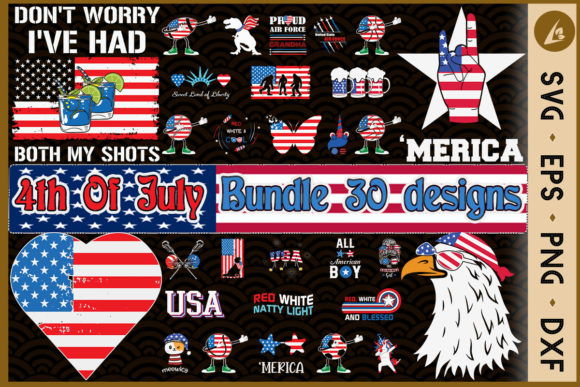
4th of July Bundle SVG 30 Designs
A Designer’s First Look: Festive, Friendly, and Ready for Real Fabric
Opening the 4th of July Bundle SVG 30 Designs, I didn’t just see holiday graphics—I saw potential stitched moments. The collection leans into warmth and approachability: think “Cute 4th Of July” rather than rigid patriotism, “Cool Butterfly USA Flag” instead of stiff iconography, and “American Flag Dog” that invites smiles, not salutes. As a designer who regularly turns digital embroidery files into finished products—custom sweatshirts for local festivals, personalized baby onesies for Etsy shops, embroidered tea towels for boutique kitchen lines—I immediately asked: Which of these will hold up under needle and thread, not just on screen?
Stitching It Out: Where This Bundle Shines (and Where It Needs Care)
I tested three designs from the 4th of July Bundle SVG 30 Designs on a mid-weight cotton tote bag, a lightweight baby onesie, and a structured baseball cap—three very different embroidery projects with real-world constraints. On the tote, the “Red White And Cool Butterfly USA Flag” design stitched cleanly: open shapes allowed satin stitch to breathe, and moderate fill stitch density kept fabric from puckering. Customers notice that polish—it signals care, not craft-store filler.
The onesie test revealed something subtler: the “Cute 4th Of July” script held legibility at 2.5 inches wide, but only with lightweight tear-away stabilizer and reduced top tension. Tiny lettering in this bundle isn’t overly dense, but it *does* rely on clean digitizing—no floating threads or jagged vector edges. That’s good news for baby embroidery and personalized gifts where softness and safety matter.
The cap was the real litmus test. Curved surfaces expose weak corners and tight curves—and the “USA Flag” motif performed well here, thanks to balanced negative space and generous curve radii. But the “4th Of July” standalone text? Slightly cramped at 1.75 inches. I resized it to 2.25 inches, rehooped, and it landed perfectly. A small adjustment—but one you’ll want to make before stitching 50 units for your craft fair booth.
Fabric & Function: Matching Design to Material Reality
This bundle works best where clarity meets comfort. For custom apparel like sweatshirt embroidery or apron front designs, lean into bolder motifs—“American Flag Dog” or the full “4th Of July” banner. Their clean outlines and moderate detail translate reliably across knit and woven fabrics, especially with cutaway stabilizer underneath.
For delicate applications—baby embroidery, pillow covers, or nursery decor—avoid the most intricate butterfly wings or flag fringe details unless you’re using high-thread-count cotton or linen. Those fine elements can blur or snag on textured fabrics or during washing. Likewise, on dark fabric, double-check thread color contrast in your embroidery software preview; some light-reds in the PNG 300 DPI files may need slight saturation boosts for visibility after stitching.
On stretchy fabric (like jersey tees) or thin cotton (kitchen towels), skip dense fill areas entirely—or reduce stitch density manually before sending to your machine. The 4th of July Bundle SVG 30 Designs doesn’t include built-in density adjustments, so treat each file as a starting point—not a final stitch file.
Commercial Use & Craft Business Practicality
If you’re an Etsy seller or small shop owner building holiday inventory, this bundle delivers smart versatility. You can pair “Butterfly USA Flag” with neutral-toned apparel for year-round appeal, or use “Cute 4th Of July” as a subtle tagline on embroidered patches—ideal for small-batch branding. As a digital embroidery file, its inclusion of SVG, DXF, EPS, and PNG 300 DPI means you can prep printable mockups quickly, resize for social listings, and convert cleanly for laser-cut applique templates.
That said—always confirm licensing terms. The product description states it’s a Graphics bundle for Crafts, but commercial embroidery rights aren’t explicit. If you plan to sell finished embroidered products (like holiday-themed tote bags or personalized caps), verify whether the license permits derivative physical goods. Likewise, if you’re reselling digital embroidery files or design assets, check whether redistribution is allowed. When in doubt, contact the seller first—saving five minutes now prevents a takedown later.
Design Notes Every Embroidery Professional Should Run
- Test first: Stitch each design on scrap fabric matching your final project’s weight and stretch.
- Check contrast: View your thread palette against both light and dark fabric backgrounds—some reds fade visually on navy or black.
- Inspect corners and curves: Zoom in on vector paths in your editing software. Jagged edges or tiny unconnected nodes cause skipped stitches.
- Confirm hoop size: Several designs scale well, but “American Flag Dog” hits ~4.5" wide—verify your largest hoop accommodates it before prepping a batch.
- Try black-and-white mockups: Simplify your preview to grayscale. If shapes lose distinction, simplify or reposition elements before stitching.
- Stabilize intentionally: Lightweight cutaway for knits, tear-away for stable wovens, fusible for layered garments like reversible aprons.
- Think beyond the holiday: “Cool Butterfly USA Flag” reads as summer, not just Independence Day—great for June–August handmade product lines.
Final Thought: A Thoughtful Tool, Not a Magic Button
The 4th of July Bundle SVG 30 Designs isn’t flashy or over-engineered—and that’s its strength. It’s a grounded, usable set of design assets built for makers who value clarity over clutter, flexibility over rigidity, and real-world performance over pixel-perfect previews. Whether you’re stitching a single personalized gift or scaling for a seasonal craft business launch, this bundle gives you honest, adaptable starting points—not generic clip art dressed up as embroidery files.
It won’t replace thoughtful digitizing for complex applique design or ultra-fine satin stitch work. But for sweatshirt embroidery, tote bag design, baby embroidery, holiday embroidery, and small shop product development? It’s a reliable, cheerful, and commercially sensible foundation—especially when paired with your own judgment, testing, and attention to fabric and thread.